
The simple act of holding hands and its big impact on your health
From lowering cortisol to boosting oxytocin, learn how this simple act of intimacy strengthens your emotional bonds and physical wellbeing.
Quick Read:
- Research shows that physical touch, such as holding hands, can actively lower cortisol levels and dampen the body’s “fight-or-flight” response to stress.
- Studies highlight that the presence and physical contact of a loved one can physically reduce the perception of pain through neurological soothing.
- Engaging in affectionate touch stimulates the release of oxytocin, the “bonding hormone,” which maximises feelings of empathy, safety, and deep emotional connection.
What’s so special about holding hands?
When you’re six years old, it’s a sweet and tender gesture as you reach for your best friend. At sixteen, it’s still sweet, a little cavalier, and framed against hormones and growth spurts. At age seventy, it’s back to achingly tender.
Somewhere along the way, however, the art of holding hands often loses its proverbial touch. What starts off with fragile poignancy as a newborn instinctively grasps a mother’s finger, ebbs into an afterthought as we prioritise more complex interactions.
We often dismiss the gesture as modest or unremarkable. Yet, in that restraint lies the true magic. Modern wellness research suggests that reaching for your loved one’s hand does more than just convey affection; it actively eases psychological stress and boosts immediate physiological wellbeing.
Hand to heart: the biological blueprint of bonding
The significance of holding hands has been documented for centuries, not just in literature, but in history. Archaeologists have discovered prehistoric remains dating back thousands of years found in a permanent, hand-holding embrace, highlighting that the need for connection is fundamentally hardwired into our species.
Psychologists note that the hand is a sensory powerhouse. When you intertwine fingers with another, you aren’t just creating a physical connection; you are building a biological feedback loop. Through the skin-to-skin contact of unacquainted friction, your body triggers the release of oxytocin. This “love hormone” acts as a neurochemical bridge, inducing feelings of trust, lowering blood pressure, and grounding the nervous system in a state of safety.
Beyond human biology, there is a certain intimacy in the topography of a hand. Feeling the familiarity of a partner’s palm or tracing the unique lines (a practice famously romanticised in palmistry), is a form of mindfulness. By focusing on the texture and warmth of another person’s hand, we anchor ourselves in the present moment, shifting focus away from anxiety and toward connection.
Touch therapy and your nervous system
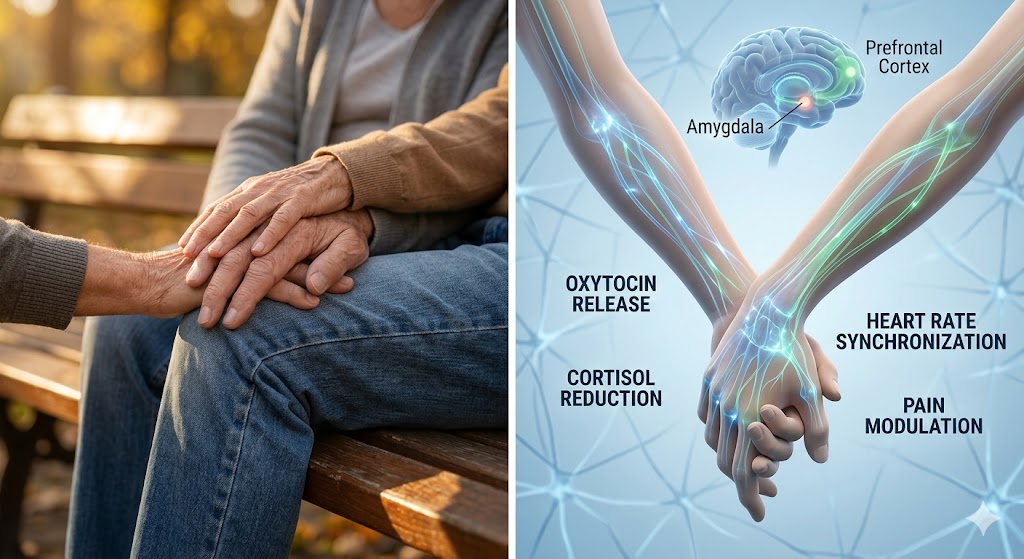
There is a profound, evidence-based reason why holding hands feels so stabilising. Touch is one of our most primal senses. When we hold hands, we activate a vast network of pressure receptors beneath the skin. These sensors send immediate, soothing signals to the brain, effectively “down-regulating” our nervous system.
The health implications are significant:
- Managing pain: A notable study published in the Proceedings of the National Academy of Sciences (Goldstein et al., 2018) demonstrated that partners who hold hands during stressful or painful stimuli experience “interpersonal synchronisation.” Their breathing and heart rates align, and the physical discomfort of the recipient significantly decreases.
- Emotional resilience: Long-term studies on human development – including research into the physiological needs of children – consistently show that affectionate touch is a prerequisite for emotional regulation and resilience.
Even in nature, this behaviour is a proven survival strategy. Sea otters, for example, clasp paws while sleeping to remain tethered to one another, a literal physical manifestation of the security we humans search for in our own relationships.
Bringing intimacy back
If you feel that the spark in your daily routine has dimmed, therapists often suggest re-learning the language of touch. No grand gestures necessary; it requires the intentionality of a small, physical connection.
As author Catherine Lacey beautifully captures in the book, Nobody is Ever Missing: “After some time my husband reached over to hold my hand, which reminded me that at least there was this, at least we still had hands that remembered how to love each other… They just held and were held and that is all.”
Did you know that “interpersonal synchronisation”, the physical alignment of heart rates through touch, can occur in as little as a few minutes of holding hands? Have you noticed a shift in your own stress levels when you make physical contact with a loved one?
Images: Freepik/Google Gemini